Fil:Earth's City Lights by DMSP, 1994-1995 (large).jpg

|


|
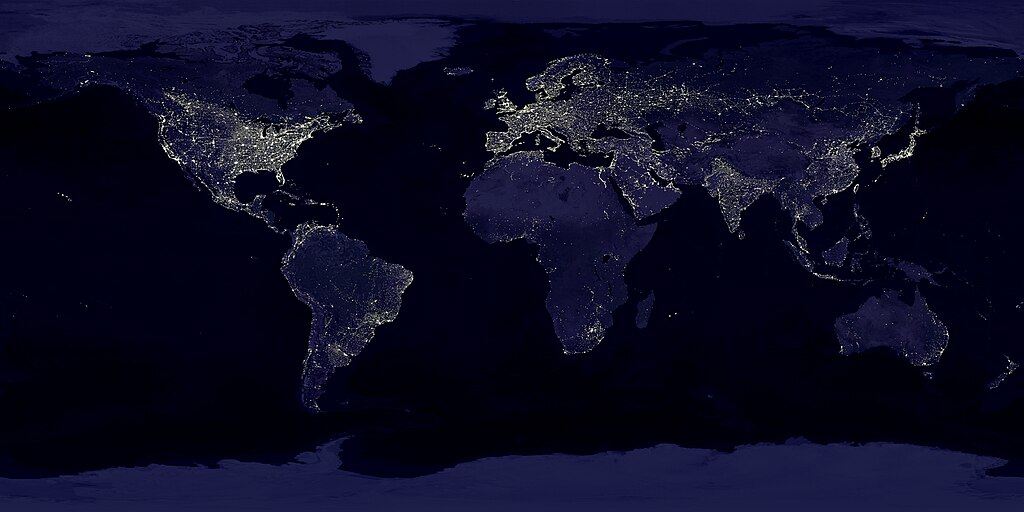
Dette billede var valgt som dagens billede den 11. marts 2006. Det var udstyret med denne tekst: English: Composite image of the Earth at night Andre sprog:
Alemannisch: Zommegsetzts Bild vun de Erd bie Nacht Čeština: Složený satelitní snímek Země v noci Deutsch: Die Erde bei Nacht (zusammengesetztes Bild) English: Composite image of the Earth at night Español: Imagen compuesta de la Tierra de noche Français : Image composée de la terre la nuit. Galego: A Terra de noite Íslenska: Jörðin í myrkrinu (samsett mynd) Italiano: Immagine composta della Terra di notte. Lëtzebuergesch: D'Äerd bei Nuecht. Magyar: Kompozíció a Föld éjszakai felvételeiből Norsk bokmål: Sammensatt bilde av jorden om natten. Norsk nynorsk: Samansett bilete av jorda om natta. Polski: Mozaika zdjęć satelitarnych Ziemi wykonanych w nocy. Português: Imagem composta de Terra à noite Suomi: Mosaiikkikuva öisestä maapallosta. Български: Съставно изображение на Земята нощем Русский: Земля ночью (составное изображение) Српски / srpski: Састављена слика Земље ноћу 日本語: 夜の地球の合成写真 中文: 地球夜景合成照片 |
|
|
This image was selected as picture of the day on Vietnamese Wikipedia.
|
Beskrivelse
| Beskrivelse |
العربية: صُورة مُركَّبة لِلأرض ليلًا.
Français : Image composite de la Terre la nuit.
English: This image of Earth’s city lights was created with data from the Defense Meteorological Satellite Program (DMSP) Operational Linescan System (OLS). Originally designed to view clouds by moonlight, the OLS is also used to map the locations of permanent lights on the Earth’s surface.
The brightest areas of the Earth are the most urbanized, but not necessarily the most populated. (Compare western Europe with China and India.) Cities tend to grow along coastlines and transportation networks. Even without the underlying map, the outlines of many continents would still be visible. The United States interstate highway system appears as a lattice connecting the brighter dots of city centers. In Russia, the Trans-Siberian railroad is a thin line stretching from Moscow through the center of Asia to Vladivostok. The Nile River, from the Aswan Dam to the Mediterranean Sea, is another bright thread through an otherwise dark region. Even more than 100 years after the invention of the electric light, some regions remain thinly populated and unlit. Antarctica is entirely dark. The interior jungles of Africa and South America are mostly dark, but lights are beginning to appear there. Deserts in Africa, Arabia, Australia, Mongolia, and the United States are poorly lit as well (except along the coast), along with the boreal forests of Canada and Russia, and the great mountains of the Himalaya. |
| Dato | mellem 1. oktober 1994 og 31. marts 1995 |
| Kilde | https://visibleearth.nasa.gov/view.php?id=55167 (image link) |
| Forfatter | Data: Marc Imhoff/NASA GSFC, Christopher Elvidge/NOAA NGDC; Image: Craig Mayhew and Robert Simmon/NASA GSFC |
| Andre versioner |
|
.jpg)
.jpg)
.png)




.jpg)

.jpg)

.jpg)
.jpg)
Licensering

|
Denne fil er i offentligt domæne i USA fordi den udelukkende er skabt af NASA. NASAs ophavsretspolitik erklærer at materiale udgivet af NASA ikke er omfattet af ophavsret medmindre andet er nævnt. (Se også Template:PD-USGov, NASAs ophavsretspolitik eller JPLs politik for brug af billeder.) |  |
 |
Advarsler:
|

Filhistorik
Klik på en dato/tid for at se filen som den så ud på det tidspunkt.
| Dato/tid | Miniaturebillede | Dimensioner | Bruger | Kommentar | |
|---|---|---|---|---|---|
| nuværende | 2. apr. 2014, 19:45 | | 4.800 × 2.400 (4,03 MB) | wikimediacommons>Tholme | Higher quality version saved from original tif. |
Filanvendelse
Den følgende side bruger denne fil:
.jpg)